Showing posts with label health. Show all posts

Thursday, July 30, 2020

How to Read Epidemiological Parameters: Going from R0 to Predicting Number of Deaths

Basic guide for using CDC data to understand how many people must die for a society to reach herd immunity (also posted on Medium)

David J. Sencer CDC Museum in Atlanta, GA (public domain image from Jim Gathany, downloaded from Wikimedia Commons)
David J. Sencer CDC Museum in Atlanta, GA (public domain image from Jim Gathany)

An epidemic is not a single number. Knowing exactly how bad an epidemic is requires knowing both how quickly it is going to spread and how bad its effects will be on those who are affected by it. To make matters worse, parameters that characterize each of these separate factors usually cannot simply be “multiplied together” to understand their composed effects. They have to be filtered through dynamical models that properly account for depletion and saturation effects in populations. So it is understandable that the average person might have a hard time making sense of CDC estimates of such parameters, and it is not surprising that there are a lot of misconceptions and misperceptions about these topics.

Let’s take the CDC COVID-19 Pandemic Planning Scenario report (as of May 20, 2020). This looks like a simple document at first, but it may be difficult to understand how to pull all of these numbers together. For a variety of reasons, parameters of interest to epidemiologists are difficult to estimate from data. One method to mitigate issues with incomplete or noisy data is to make assumptions that help fill in the gaps, but then your analysis is only as good as your assumptions. To be conservative and to understand how sensitive predictions are to these assumptions, the CDC has come up with five different “scenarios” that stretch across a wide range of assumptions. To keep things simple, we will focus on “Scenario 5: Current Best Estimate”, which is the CDC’s best guess at where these epidemiological parameters are.

It is best to start with everyone’s favorite epidemiological parameter, R0. This is the so-called “basic reproduction number.” It is a measure of how fast a contagious infection can spread. R0 is the combination of three factors:

  • The rate of interaction between an infectious (contagious) person and others in the population (referred to as “contact rate” below in some places)
  • The probability that an infectious person will infect someone that they come in contact with
  • How long an infectious person stays infectious (we assume that after this period, they are in a permanent recovered state where they are immune to further infection)

Essentially, R0 is a ratio of the rate that an infectious person infects others to the rate that an infectious person becomes well. This ratio can be interpreted as the number of people an infectious person infects before they themselves stop being infectious. If R0 is less than 1, then a disease will naturally die out because (on average) those infected will not be able to infect someone else before they become well. If R0 is greater than 1, then we have a so-called endemic. That means that the infectious disease will be constantly maintained at some background level; some fraction of the population will always be either currently infectious or recovered. Interestingly, this fraction is not 100%. As an infectious disease spreads through a population, the number of those who are susceptible to further infection declines to a point where it is rare for infectious individuals to encounter them (contacts with infected and recovered are far more common). This means that when susceptible individuals are rare, each infectious individual spreads less of the infection during the time window that they are infectious. This is the so-called herd immunity. A fraction of the population can stably remain susceptible because they are protected by the large numbers of others who have already had the disease and buffer them against contact with those who are currently infectious. The fraction of the population that will remain susceptible at the so-called endemic equilibrium is 1/R0. Likewise, the fraction of those in a population that must have been infected (or vaccinated, if possible) in order to achieve herd immunity is (1–1/R0). I should note that this simplified model assumes that infectious people eventually become recovered and stay that way; things get more complicated if immunity is not long lasting.

So what does the endemic equilibrium (“herd immunity”) look like for COVID-19 (assuming long-lasting immunity)? Here is what CDC estimates for R0.
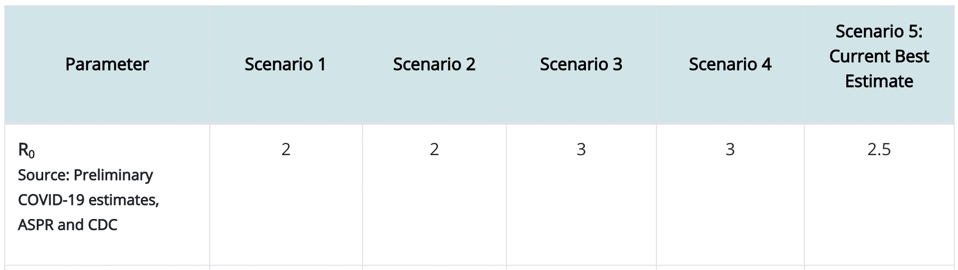
CDC estimates of R0 for COVID-19 for different scenarios. R0 is shown to be 2.5 in most likely scenario.
CDC estimates of R0 for COVID-19

Again, focusing only on Scenario 5, we take R0=2.5, which means that any infectious person will have an opportunity to infect 2.5 other people on average. So we then estimate that 1/R0=1/2.5=40% of the population will be able to avoid infection so long as the other 60% of the population goes through an infection or is vaccinated. So exactly how many people is that? In the United States, the population is a little over 325 million people (compare this to the world population of 7.8 billion people). So that means that 60% of the 325M people in the USA must be infected to achieve herd immunity. That’s 195M people in the USA (4.68 billion people worldwide).

But not everyone who is infected sees symptoms let alone has to go to a hospital or suffers an early death. If we go back to the CDC data, we see that…
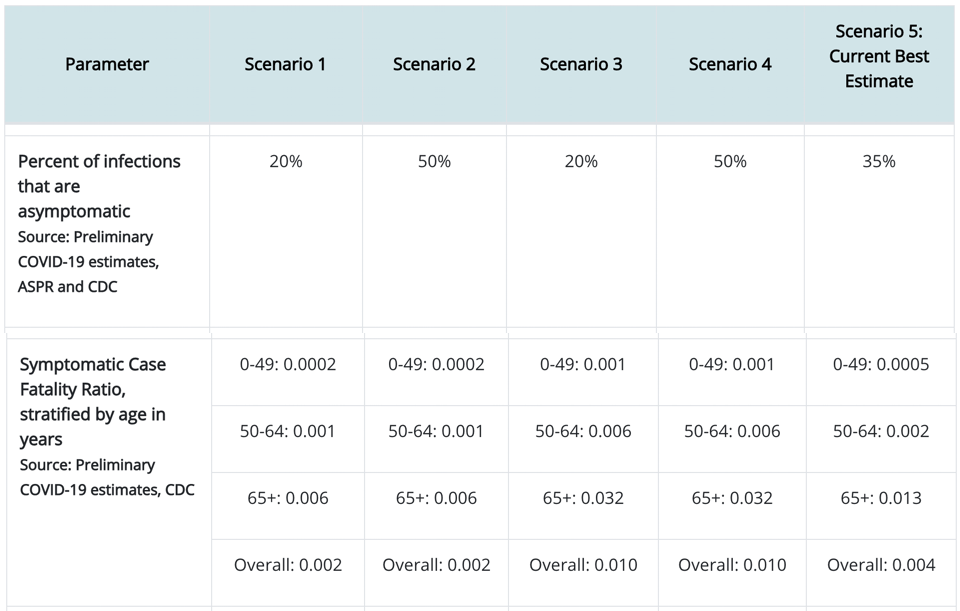
CDC estimates for asymptotic ratio and symptomatic case fatality ratio for COVID-19. Most likely estimates are 35% and 0.004.
CDC estimates for asymptotic ratio and symptomatic case fatality ratio for COVID-19

Again, looking at Scenario 5, we see that 35% of those who have an infection show no symptoms. We also see that those other 65% who show symptoms will suffer fatality at an overall (averaged across age groups) rate of 0.004 (i.e., 0.4%). That seems like a very small number! But we have to keep in mind that this is a very contagious disease (any infectious person infects 2.5 other people). So we need to combine the information on contagion with the information on case fatality rate. For the 325M people in the USA, we already calculated that 195M will have the disease. So then, at the endemic equilibrium (“herd immunity”):

  • 195M*65% = 127M people will have shown symptoms in the USA
  • 127M*0.4% = 508,000 people will die in the USA

And worldwide, we would expect 12.2M people will die. So even at that very small case fatality rate, there will be a lot of death (and even those that escape symptoms may still feel long-term effects of COVID-19 that we are only starting to understand now). Just as a reference, 38,000 people died in car accidents in 2018 in the USA. We try to prevent deaths by car accidents by preventing car accidents and trying to make cars safe so that people will survive accidents that happen. When we ask people to wear masks and social distance, this is not unlike people’s legal obligation to wear seatbelts and drive cars that meet safety standards.

Now, a lot of people say that there is no way to prevent these deaths, and so it is better to suffer them early instead of dragging out our march to the endemic equilibrium. In order to evaluate whether this is a good argument, we should take a look at another part of the CDC data:
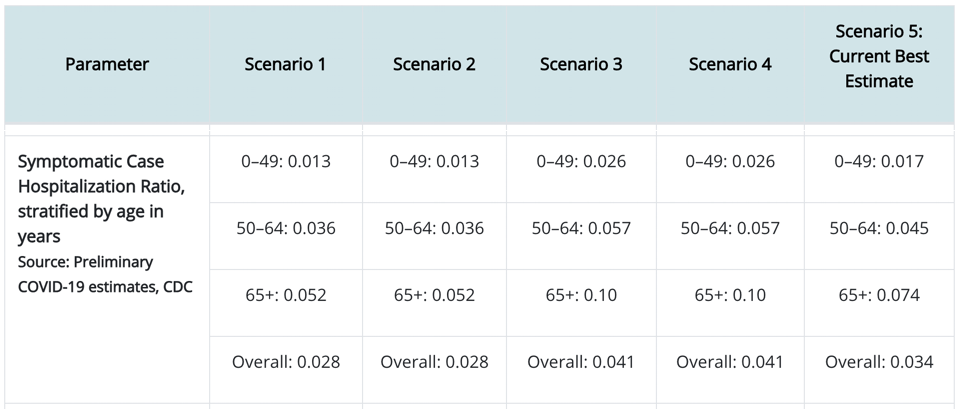
CDC estimates for symptomatic case hospitalization ratio for COVID-19. Most likely overall estimate is 0.041.
CDC estimates for symptomatic case hospitalization ratio for COVID-19

Focusing on Scenario 5’s “Overall” estimate, we see that each person who shows symptoms will have a 3.4% chance of being hospitalized. So that means we can estimate that for the population of 325M people in the USA, the 127M people we calculated above to show symptoms, 3.4% of them will have to be hospitalized, meaning that COVID-19 contribute 4.318M patients to hospitals in the USA (103M COVID-19 hospital patients worldwide). The question is whether we have enough hospital beds in the USA to accommodate these 4.318M people all at once. If we do not, then those that would have otherwise recovered will have to suffer through the disease without the support of medical professionals and medical technology. In other words, the case fatality rate for this subset of COVID-19 symptomatic individuals turned away from hospitals may rise to much higher than the 0.4% mentioned above. So this is really the essence of the movement to flatten the curve (e.g., by wearing masks and social distancing to reduce the effective contact rate). Even if it is impossible to avoid the 508,000 deaths predicted above, if infections can be spread out over a long amount of time, we can help to ensure that at any instant there will be enough hospital beds. Furthermore, if we stretch out the infection curve far enough, we may develop a vaccine within the curve’s duration. Vaccinations are a game changer because they provide a quick shortcut (that is hopefully much safer than a full-blown infection) to herd immunity.

But if we wanted to reduce that 508,000 without a vaccine, how would we do it? Remember that I said that R0 (a parameter of infection spread) is determined in part by the rate that an infectious individual contacts other individuals in the population. If we can devise long-term behavioral or technological methods to reduce this contact rate (beyond temporary inconveniences, such as wearing masks), then we can change R0 for COVID-19 for good (or at least for a sufficiently long time), thereby meaning that our endemic equilibrium (“herd immunity”) will occur with a much higher number of people who avoid infection (and even vaccination) entirely. How do we do that? Here are three potentially powerful ways.

  • We can remove hand shaking and other similar kinds of contact as a greeting (thereby bringing the baseline contact rate for every individual in the population to a much lower level than it was before COVID-19).
  • We can develop rapid, highly available, and frequent testing protocols that can quickly identify infected individuals so that they can be isolated (thereby bringing their personal contact rate much lower than others).
  • We can develop sophisticated contact-tracing techniques that can further identify potentially infected individuals so that they can be isolated (thereby bringing their personal contact rate much lower than others).

These behavioral and technological changes can actually improve our long-term COVID-19 outcome even if a vaccine is not developed. So it may not be inevitable that hundreds of thousands of more people have to die (at the time of this writing, over 110,000 people in the USA had death certificates that indicated COVID-19 as a cause of death).

Medical professionals can develop vaccines, researchers can develop novel technologies, and we can all alter our behaviors. Unfortunately, there are additional challenges in the near future that will make all of this even more urgent. In particular, we are facing a flu season ahead of us. Individuals who contract COVID-19 and the seasonal flu simultaneously may be in an untenable situation. Additionally, the medical system will face demands not only from COVID-19 but from those with the flu (but possibly not COVID-19) who also need hospitalization. Normally the medical system would have enough capacity to serve the seasonal flu population (although there are still seasonal flu deaths every year, just not as much as COVID-19). However, if the medical system has to face flu and COVID-19 along with baseline demands and any other emergent demands (other pandemics, etc.), then that will put our society as a whole in an untenable situation. The flu shot may be especially important to encourage this season.

Of course, there are many other interesting figures in that CDC report that we could further analyze that relate to how long the average COVID-19 hospital patient takes to recover, which would help us figure out more quantitative details about the amount of each of the kinds of possible actions discussed above will be necessary to prevent hospitals reaching capacity. For now, I will leave that analysis as an exercise for the reader. In the meanwhile, get some rest, stay safe, and stay healthy!

Wednesday, April 24, 2019

Long, non-coding RNA serve an important role in the regulatory pathway controlling human skin wound healing

It seems like there has been a lot of cool wound-healing research results published lately. At the end of March, there was the result that bacteriophages hide their bacterial hosts from being cleared by mammalian immune response. Last week there was the result that aphids soldier nymphs use their own wound-healing proteins to plug gall holes. And now there's this new result on the mechanism underlying the role of long, noncoding RNA (lncRNA) in wound healing of human skin.

So what's long, non-coding RNA? The DNA in the human genome has to be converted to RNA, in much the same way computer code might be converted into assembly language, before it can then be converted into proteins (like assembly language being converted into object code that can actually be executed by the computer). Up until recently, biology has focused entirely on this pipeline -- DNA to RNA to protein. However, there are some bits of DNA that stop at RNA, which are termed "non-coding RNA" because they don't end up producing any proteins. They just float around until they naturally break down. However, there are hints that they are not merely intermediate transitional objects and that they can be functional molecules themselves. One of those hints is that they can be consistently turned on ("up-regulated") in certain situations. However, this doesn't mean that they're actually doing anything. There are technical details that make it useful to distinguish whether these non-coding RNA are short or long. I won't get into those. Just know, for the reset of this post, that "lncRNA" represents "long, non-coding RNA", which is a type of these mysterious molecules. When healthy human skin is wounded, the normal response happens to involve the up-regulation of one of these lncRNA's is consistently generated more than in undamaged tissue, but no one knows why.

In this paper, they show that the molecule actually sequesters other mechanisms within the tissue that would normally turn off the migration of cells important for wound healing. So the lncRNA's are functional -- they get turned on when the skin is wounded, and that sets of a chain reaction that disables other mechanisms that would normally keep wound healing processes turned off. So the lncRNA's are an important step in the regulatory network. That's very cool. It not only helps scientists understand wound healing but also one more way in which lncRNA's can be functional -- not just junk molecules floating around waiting to be broken back down.

Here is the primary source:

"Human skin long noncoding RNA WAKMAR1 regulates wound healing by enhancing keratinocyte migration"
by Li et al.
PNAS (2019), early edition
https://doi.org/10.1073/pnas.1814097116

Significance
=====
Although constituting the majority of the transcriptional output of the human genome, the functional importance of long noncoding RNAs (lncRNAs) has only recently been recognized. The role of lncRNAs in wound healing is virtually unknown. Our study focused on a skin-specific lncRNA, termed “wound and keratinocyte migration-associated lncRNA 1” (WAKMAR1), which is down-regulated in wound-edge keratinocytes of human chronic nonhealing wounds compared with normal wounds under reepithelialization. We identified WAKMAR1 as being critical for keratinocyte migration and its deficiency as impairing wound reepithelialization. Mechanistically, WAKMAR1 interacts with DNA methyltransferases and interferes with the promoter methylation of the E2F1 gene, which is a key transcription factor controlling a network of migratory genes. This line of evidence demonstrates that lncRNAs play an essential role in human skin wound healing.
=====

Abstract
=====
An increasing number of studies reveal the importance of long noncoding RNAs (lncRNAs) in gene expression control underlying many physiological and pathological processes. However, their role in skin wound healing remains poorly understood. Our study focused on a skin-specific lncRNA, LOC105372576, whose expression was increased during physiological wound healing. In human nonhealing wounds, however, its level was significantly lower compared with normal wounds under reepithelialization. We characterized LOC105372576 as a nuclear-localized, RNAPII-transcribed, and polyadenylated lncRNA. In keratinocytes, its expression was induced by TGF-β signaling. Knockdown of LOC105372576 and activation of its endogenous transcription, respectively, reduced and increased the motility of keratinocytes and reepithelialization of human ex vivo skin wounds. Therefore, LOC105372576 was termed “wound and keratinocyte migration-associated lncRNA 1” (WAKMAR1). Further study revealed that WAKMAR1 regulated a network of protein-coding genes important for cell migration, most of which were under the control of transcription factor E2F1. Mechanistically, WAKMAR1 enhanced E2F1 expression by interfering with E2F1 promoter methylation through the sequestration of DNA methyltransferases. Collectively, we have identified a lncRNA important for keratinocyte migration, whose deficiency may be involved in the pathogenesis of chronic wounds.
=====

Tuesday, June 26, 2007

Eating Tips

This year, a bunch of people have asked me for eating tips. This is because I went from 220+ pounds to 185 pounds in a couple of months. I didn't mean to lose that much weight--I just wanted to come up with an eating schedule that would save me money in graduate school.

I recently posted the following at 43things. I hope it will be helpful to someone. I shared these tips with a few people I know, and I found out that they recently lost a bunch of weight as well. I don't think there's anything unique about this. The basic idea is to eat smart. Just think about what you're eating, why you are eating it, and what you think it is going to do for you.
It's all about eating more often (you should never be hungry) and eating smart. I never expected to lose weight; I just wanted to get on an eating schedule to save money while in grad school. After a couple of months, I found myself almost 40 pounds lighter.

Some general rules:

* Cut out soda

* Cut out high-fructose corn syrup.

* Cut out PROCESSED sugars (fruits and veggies are fine; flavored juices are not)

* Frozen fruits are fine -- they'll keep better anyway; microwave them if you can't stand them being cold and hard.

* Cut out orange juice; try tomato juice and grapefruit juice instead (grapefruit juice will make you feel fuller longer)

* Cut out salad dressings except for vinigrettes (vinegars and grapefruit juices have a similar beneficial effect on keeping you full and lean)

* Avoid bread unless it is made with whole grains. The worst part of a McDonald's cheeseburger is the bun. Read the ingredients on most bread -- it is nearly impossible to find a bread without high fructose corn syrup on it. There are simply too many empty calories in most breads (an "empty calorie" is a calorie that does not make your stomach feel full because your body has not been adapted to process it; this is much of what's wrong with high fructose corn syrup).

* Consider quinoa (pronounced "keen-wah") as an alternative to rice. Lots of protein. Plus it's LEAFY (rather than grassy) so it has amino acids in it.

* Nuts (especially almonds) are wonderful. High protein. High fiber. Vegetable fats. However, each day try not to eat more than an Altoids-tin full of almonds and a tablespoon (or 2 MAYBE) of peanut butter. That's all you need.

* *NATURAL* peanut butters are wonderful. Unnatural ones are awful. Look at the ingredient list. Generic Meijer peanut butter is JUST peanuts and is CHEAP. This is ideal.

* Ground flaxseed is wonderful. Add it to everything. Omega-3's and all the benefits of nuts.

* Proteins stay in the stomach longer and so keep you fuller longer and keep your meals small. Fish stays in the stomach the longest, but you shouldn't eat more than 3 servings of fish a week because of all of the heavy metals found in fish.

* Soluable fibers stay in the stomach longer and, as an added bonus, pull cholesterol out of the blood. Insoluable fibers are also filling and keep you regular. RAMP UP fiber intake though--natural selection needs to act on your GI cultures so that you are setup to process all of that fiber. This can take up to two weeks if you aren't used to that much fiber.

* The longer things stay in the stomach, the more calories you burn digesting them. You actually work out your body by eating proteins.

* The colder things are in the stomach, the more calories you burn processing them.

* The heavier your food utensils are, the fuller you'll feel.

* GREEN TEA is wonderful. If you didn't like one green tea you tried, try another type. There are as many varieties of green tea as there are of black tea. Don't group them all together. Try taking green tea supplements. Try to drink multiple cups of tea a day (maybe 4 or 5).

* MAKE YOUR LUNCHES IN THE MORNING: This forces you to eat them rather than going out. Plus, the additional activity in the morning wakes you up and increases your calorie burn.

* Increase physical activity: take the steps, walk, hold your arms at a right angle when carrying groceries rather than letting your arms hang, be as inefficient as possible in your locomotion, add instability to your locomotion, do chair lifts, do pushups in the morning (one set of 30 is a good goal)

* TAKE LOTS OF VITAMIN D. There are some weight/health benefits of dairy, but they come with increased cancer risk (because human beings are only marginally well adapted for cow's milk). Vitamin D has so many benefits and everyone needs more of it. Among those benefits, it will reduce the cancer risk of dairy intake. I take 1000 IU's 3 times a day, plus I try to spend at least 15 minutes in the sunlight. You probably don't want more than 15,0000-20,000 IU, but that's hard to do.

* MEN: Get lots of blueberries and lycopene. Lycopene is in most red fruits and vegetables, so focus on red fruits and vegetables (watermelon, TOMATOES, etc.).

* Cinnamon can be added to most everything, and it probably should be. It has lots of benefits. Among those, it will decrease diabetes risk.

* SPICEY THINGS increase meatabolic activity. Make your food spicey. Remember that vinegar is a great thing to have in the diet, so try hot sauces that use vinegar.

* EAT WHEN HUNGRY. It's okay to eat often. Eat things that stay in your stomach longer (add grapefruit juice or vinegar before the meal to help increase this time). Just try to eat smart when you eat. Eat until full and STOP. Make sure you're actually hungry. Very often you're THIRSTY, so keep a bottle of watter nearby. **TEA** (like green tea) will do wonders in keeping you feeling full.

* COFFEE can be great (caffeine isn't necessarily bad). However, be sure you don't add much to it. Also consider skim milk options if you must have milk. Don't drink as much coffee as tea, but don't be afraid of coffee. It's much better than pop.


Some meal ideas from my schedule:

* Breakfast: **POST** Raisin Bran (Post's has no high-fructose corn syrup and has 8g of fiber, 4g soluable and 4g insoluable) with 2g ground flaxseed added. I also add frozen strawberries, cherries, blueberries, blackberries, and raspberries as well as 25g of protein powder (and as of recently 1 heaping tsp of fiber sure, which gives 5g of soluable fiber)

* Between Breakfast and Lunch 1: 1 fiber choice chewable tablet (2g soluable fiber) (this is recent; I don't like the sugar content of these though)

* Lunch 1 (around noon): Slim-Rite Ultimate (Kroger version of Slim-Fast Optima; Target has a cheaper version that is just as good) shake and a red delicious (produce #4015) apple (lots of soluable fiber in the apple keeps you full; if you need more, try a #4016 apple).

* Between Lunch 1 and Lunch 2: 1 fiber choice chewable tablet (2g soluable fiber) (this is recent; I don't like the sugar content of these though)

* Lunch 2 (around 3pm): 1 cup of Dannon Light and Fit yogurt (any flavor) mixed with 2g ground flaxseed and initially frozen (they melt during the day in the refrigerator) strawberries, cherries, blueberries, blackberries, and raspberries. I also add a handful of almonds. Recently I've added 1 heaping tsp of fiber sure as well.

* Dinner (around 6pm): Something hearty. Good protein. Lots of vegetables. Try to get 3 servings of fish per week.


I haven't figured out how to work exercise into my schedule yet. Optimally, exercise is great for the body. However, if you can just EAT better, you'll do wonders for yourself. (I don't mention it here, but I also focus on healthy nutrients that have nothing to do with weight loss directly--you should find out what nutrients are best for you and adust your own diet accordingly)