Showing posts with label academia. Show all posts

Thursday, March 11, 2021

Who should write you a letter of recommendation?

[this was originally posted as a Medium article]

There are a few times every year when faculty members are bombarded with requests to write letters of recommendation for students. Sadly, we do not do a good job telling undergraduate students what kinds of relationships they should be building with faculty to ensure that when the time comes (e.g., applying for graduate school or medical school), there will be two or three different faculty who feel comfortable writing a recommendation letter.

A good recommendation letter must do much more than just verifying a grade in a class. Students applying for graduate school will be asked to submit verified transcripts, and so the veracity of reported grades will not be in question. Furthermore, if all a letter writer can do is verify a grade in a course, then that actually speaks negatively for the student because it indicates that the student could not find a letter writer who could supply a stronger message. In fact, some of the best letters are from faculty who can address why an admissions committee should overlook a low GPA or a poor grade. The best letters are not about grades, they are about people.

Students should keep in mind that every person that they ask to write them a letter will be given a form like the one below and an opportunity (which is expected that they will take) to write a 1–2 page free response reflecting on the student and their potential for the program for which they are applying.
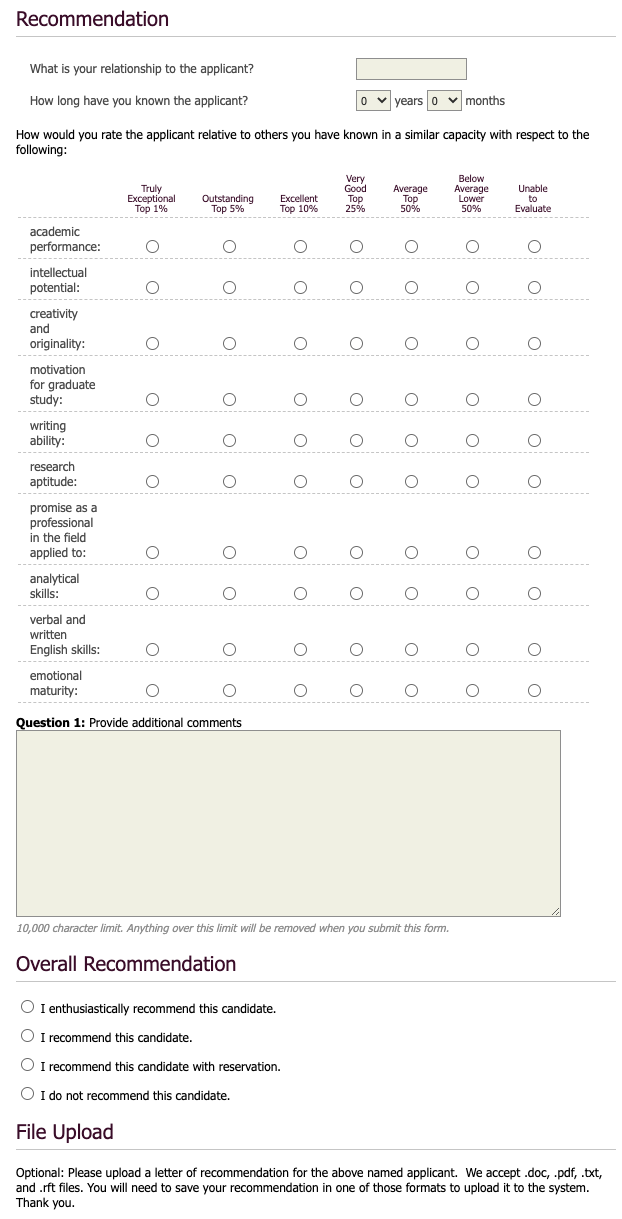
Example questions from an actual recommendation letter form for a graduate school application
Example questions from an actual recommendation letter form for a graduate school application (click to expand)

Although the forms for each graduate program have slightly different questions, they all ask questions very similar to the ones above. If a student asks me for a letter, and I have never had an office-hours conversation with the student before (let alone exchanged an e-mail), it would be very difficult for me to attempt an answer to any of those questions above. At a minimum, I need to understand a student’s career goals and motivations for graduate study. It is ideal if I have worked with the student on a project (e.g., undergraduate research), but often just one or two good conversations during office hours is enough for me to attempt answers to the questions above and even write a one-page letter that does much more than just confirm the reported grade for my course.

So, choose wisely when picking letter writers. The best letters are going to be very personal and specific to your case and will address any parts of your application that you think might make you look weaker than other candidates (e.g., a low GPA or low grades). How do you make sure you will be able to pick a good letter writer? Start early. If you have time, try to get involved in some projects with faculty so that they have experience working directly with you. But even if you can’t do that, just go to office hours and chat with the faculty member about your career goals. Ask questions about graduate school, and maybe you’ll learn something interesting.

If you didn’t know to do this during your undergraduate degree, it’s not too late to schedule a meeting with one of your old professors. Tell them that you are considering graduate school and wanted to ask a few questions and get their reflections about your chosen career path. Just ten or fifteen minutes in conversation is enough to turn a recommendation letter into something that looks like it was written by a robot to something that will go a long way to getting you passed the admissions committee.

Friday, September 04, 2020

Advanced Zoom: Using Slides as Virtual Background

There is a beta feature in Zoom (version 5.2.0 and higher) that is easy to miss but can make for a slightly more exciting way to share slides. When sharing your screen, try clicking on the "Advanced" tab (top center) to reveal several useful options:

There is a beta feature, "Slides as Virtual Background," that lets you choose a slide presentation. Sadly, it only supports PowerPoint presentations at the moment. This is strange because it first converts the PPTX to a PDF and then displays the PDF instead (which means your animations and slide transitions will be removed). So it seems like they should be able to support a PDF directly. I am hoping that will be added in the future.

Once you select a presentation, it will display behind you. It shows you a slide advancer (to move through your presentation). It also allows you to move yourself around the slide and re-scale your size. You can do this live, which lets you place yourself next to important features of the slide (or move yourself off of important features). By default, it scales you down and puts you in the bottom right corner.

Again, this will be much nicer when it supports PDF's in general (as opposed to just PPTX). 

CAVEAT ABOUT RECORDINGS: For now, the merged video (showing speaker on top of slides) will only record if you select to record locally. Cloud recordings will capture the unmerged view. I suspect that eventually they will implement this feature in their cloud backend and the merged view will be able to be seen there too. However, at least for now, if you do this and want it recorded, make sure that you record locally.


Friday, June 12, 2020

Animal Behavior virtual conferences for Summer/Fall 2020 that are free (or nearly free)

A silver lining of COVID-19 is that amazing conferences have become far easier and far cheaper to attend. For interdisciplinary researchers, you can now dip your toe into venues that you might not otherwise be able to justify spending the resources on. So it is a great time to branch out!

As an example, there are FOUR virtual Animal Behavior conferences that will be taking place soon this summer or early fall. They are free or nearly free (at least for students), and all of them are still accepting talk/poster abstracts at the time of this posting. If you are doing empirical or theoretical work in animal behavior and would normally present your work at a more methods-based conference, this is a great opportunity to get feedback from the larger behavior community. If you are not currently directly researching behavior, you might really enjoy just hearing reports of great, state-of-the-art research into animal behavior.

My background is in engineering, and I have found that animal behavior conferences to be the most educational and useful in generating bio-inspiration for me. These conferences showcase how animals interact with each other and the world around them in potentially adaptive ways. Plus, it's a great showcase of natural history for those who don't feel like they are naturally naturalists!

So check these out. And this is probably not an exhaustive list!
  • ABS 2020 Virtual Meeting [USA animal behavior]
  • Animal Behavior Live [new annual venue; global]
  • ASAB Virtual Conference [British animal behaviour]
  • ASSAB Virtual Conference [Australian animal behaviour]
    • Free registration
    • [ info coming soon ]
    • Conference: 28th September – 1st October, 2020
    • https://www.assab.org/

Monday, May 04, 2020

Reduce Student Anxiety: Introduce them to "What-If Grades" in Canvas Gradebook

Are your students getting anxious and wondering what their final grades might look like under different “what-if” scenarios related to any assignments yet to be graded? A lot of faculty and students don’t realize that the Canvas gradebook supports “What-If Grades”, which allow a student to click on any grade (even ones not posted) and change it to a hypothetical version to see what the hypothetical effect would be on their final grade.

Check it out:

Wednesday, April 17, 2019

How to write a scientific paper, in four simple steps

Accomplished scientific writers will all have their own tips on how to go about writing a scientific paper. However, when you are first getting started, sometimes it is easier to have a set of steps available. Certainly there are many options available, but I personally have been finding the following set of steps useful when advising students lately.
  • Step 1: Write the Introduction (starting with second paragraph)
    The introduction lays out why you bothered to do the study you did. It provides a background from the existing literature, and it points out holes in that literature or opportunities to test answers to questions that have little coverage.

    However, the first paragraph of your introduction (in fact, the first few sentences of your paper) are often the hardest ones to write. A colleague points out to her students that a great way to get around this potential writer's block is to simply skip the first paragraph. If you start with the second paragraph, you can immediately start laying out the argument for why your study needs to be done. Once you finish the rest of the introduction, it may be easy to see what the first paragraph needs to be. In other words, once you have 75% of the argument completed, the shape of the puzzle piece that remains will often be clear.
  • Step 2: Write the Discussion
    If someone is already convinced that your paper has something interesting to say, that person will likely jump straight to the discussion and start reading there. This is where you describe how your data support some story that you want to tell about an inference you have made about the natural world. As you write your discussion, it will become clear exactly which data you need to tell your story. And so that brings us to the next step.
  • Step 3: Write the Results
    Now that you have crafted a convincing discussion, you know what results are needed to support your argument. Writing the discussion first tells you what to include and what you can exclude. A lot of students make the mistake of starting with all of the possible plots that can be generated and then trying to string together a discussion around them, even if some of those plots really aren't needed. Don't do it that way. Instead, let your discussion guide which results to include.
  • Step 4: Write the Methods
    Putting this step here is controversial. In many cases where your study has a clear experimental design that tests for something very specific, then it is possible to write your methods first. However, if you are instead working with a very large dataset that might someday result in multiple papers, then your methods might need to wait for you to determine exactly which results you need to make your argument. So once you've written your results, you can then generate methods that explain how all of those results came about.
Those four steps can often soothe writer's block on a scientific paper. You may determine a different flow as you mature in your writing process, but this is just one suggestion of where you might think about starting.

Special Note: Title and Abstract

Of course, two things that are left out of the steps above are the title and abstract. Young writer's often leave these until the end, and they often view them as complementary to the rest of the article. However, with maturity, it should be possible to write them first and view them almost as alternatives (or marketing pieces) for the whole article. Writing them first can also provide structure (similar to an outline) for the rest of the article. So work toward being able to write these two things first, but it's OK if you start by writing them last.

Keep in mind that most readers will only read the title and abstract (and some will only read the title). Consequently, the title should not be clickbait; the title should be an executive summary of the article, giving the punchline as opposed to begging the reader to read further. Interested readers will move on to the abstract. Consequently, your abstract should really have everything an educated reader needs to reconstruct your article; it should have a little bit of all of the sections. Your abstract should concisely say why you did the things you did, how you did them, what the main results were, and why those results are interesting.

Take-away Message: It's About the Reader

People are busy, and they allocate their reading resources accordingly. If you tease them with half statements, they will only get frustrated and move on to the next thing that competes for their time. Instead, give them something interesting and complete in the title. If they want more details, they can read the abstract, which should itself be complete. If they want more details, they'll read the main body (possibly starting with the discussion section). For the reader, it's about sequentially choosing what to read next. When you write, you should always have this in mind as you design the delivery vehicle for the content you hope will be disseminated broadly.

Friday, March 01, 2019

Early Career Academics: Tips for Preparing for your Interview Visit

This post goes out to early career academics about to interview for positions. Preparing for your interview is very different than preparing for just another seminar visit. Moreover, the observable difference between a well-prepared candidate and one who sees the interview as  just another invited seminar visit is HUGE. Do yourself a favor and ask faculty you know how to prepare. Most faculty, even junior faculty, have served on at least one search committee and will have a lot of good perspectives from sitting on the other side of the interview process.

This post gives a few tips that I've picked up after sitting on search committees. Your mileage may vary, and you should definitely ask around. But this is what I notice...


Given that your audience will be with everyone you meet that day as well as everyone who sees your presentation (which may be video taped and viewed in a tiny screen, which is something you might want to consider when crafting it), you should survey several people to see what sticks out for them about good and bad candidates. Ultimately, people make up their minds very quickly based on relatively small things. The search committee might have combed through your CV, and certainly some who submit feedback to the search committee about your visit will have as well, but many will make their decision during your talk (or multiple talks, in the case of some departments) and/or in the few minutes they have had to talk to you during a half-hour meeting or over a meal. So get a good idea of what "many people" might like.

So below I've put some good general tips from my perspective. Again, your mileage may vary.

FIRST, THE NON-TALK-RELATED TIPS (talk tips in next section)

It's not all about the job talk. I've given job talk tips below, and the job talk is extremely important -- one of the most important talks you'll give. However, there is a lot of the day(s) that won't be the job talk, and you need to be prepared for all of the interactions you'll have. So I put the non-job talk tips first.
  • DO YOUR (VIRTUAL) RECONNAISSANCE IN ADVANCE! When you find out you are going to be interviewing, you may not know who exactly you will meet that day. Even when you're given the schedule, there may be last-minute additions. So if you can, do your best to memorize who all of the faculty are and know roughly what they do (up to a 2-sentence description). You may not know who the search committee is, but you should use whatever clues have been made available in the communication thus far to be able to spot them in a crowd so that you know they're coming. You never want to be in the position where you have to ask someone what they do. You want to make it seem like you are genuinely interested in their research and can ask intelligent questions about it. You also want to try to anticipate what they find valuable and adjust your answers to questions to be complementary to these perspectives.
  • Try to understand how the school is structured and where your position would fit in that structure. Try to understand what resources are available. Be able to tell someone what specific things attract you to that school or that program. Make it look like you've been waiting for this particular position to open and jumped on the opportunity as opposed to just interviewing at any random school.
  • Be very courteous and approachable and never dismissive. Be comfortable. Do your best to be relaxed and conversational while also internally keeping up a little bit of a guard. You don't want to be too quiet, but you want to be more professional than you usually are on an average visit. You aren't required to answer certain classes of personal questions (whether you have a spouse, kids, plans for these things, etc.), and so you can divert if they happen to come up casually, or you can try to use them if you think they would be an advantage. But don't give up too much information about things that could make it difficult for you to accept a position. Those tricky details can come out during negotiation.
  • Keep in mind that you want faculty to want to work with you. You want them to be excited about collaborating with you.
  • Keep in mind that you will also be evaluated based on whether there is too much overlap with existing faculty. Do your best to emphasize the new things you can bring (without accidentally pointing out weaknesses in other faculty or the program as a whole).
  • You may be given 30 minutes alone with graduate students. Prepare for this time by having a set of questions that you can ask them (in case they don't have much to ask you). You have already studied up on all of their advisers, and so you should be prepared for the different research directions they have and can maybe anticipate some of their answers. But let them speak. You want them to see you as another faculty member that they would want around as a resource. Their advisers may ask them how they felt about the interaction.

JOB TALK TIPS:

And here are the general comments about job talks. See the previous section about non-job-talk related tips (in short: DO YOUR RECONNAISSANCE and BE COURTEOUS)...
  • Practice your job talk before hand so that your timing is flawless and you are clearly confident with the material. And get your timing and talk density right so that you END WITH TIME FOR QUESTIONS. Ten minutes is sufficient. But don't leave more than 15 minutes. But if you leave less than ten minutes, people will not be impressed (and may even be annoyed).
  • Make sure your job talk tells a consistent narrative that gives everyone in the audience an idea of what your research vision is and how your career up to this point has successfully implemented that vision. This may not be true a priori, but you need to find a way to tell your story to make it seem true. People don't want to see a random collection of research. They want to use the talk to get to know you, what you've done, what you will likely do in the next 3–5 years, and be impressed with both the current body of work and the potential. With that in mind, you don't have to present everything if some things don't contribute to the broad overall narrative. If you still have some work you're proud of that you don't think fits a narrative, you can include it briefly as a kind of "Other things that I am interested in" near the end to show you have breadth. But don't hop back and forth between disconnected projects. People will forget what you're all about and get frustrated by the lack of consistency.
  • If your work has been published or presented at major conferences, call out these venues in your presentation as you go through them. You want people to be convinced that other people care about your work. Don't hit them over the head with giant bibs, but maybe include a small parenthetical ref at the bottom of slides here and there and then say things like, "In work I presented at .... last year," or, "In work that came out in ... a few months ago..."
  • If you have more work than just your PhD work, be sure to show it somewhere. People like to get a sample of what you'll do as an independent researcher. Sometimes just the PhD work doesn't quite capture that.
  • Include at least a few slides on future directions. You don't want people wondering what you'll do next. Pointing out where you have already received funding is a good thing, and it's definitely good to identify where you'll go next for funding (agencies or even particular programs). Some sort of flowchart showing how your research vision can be divided into specific threads that meet the objectives of these different agencies is great as it is more convincing that your vision can be operationalized for the next 3–5 years.
  • Figure out if you are in a discipline (or even a school) that cares so much about education that a significant portion of your job talk should be associated with your classroom innovations and perspectives.
  • When you get to the end of your talk and are taking questions, try to maximize for the quantity of questions. Don't dwell on one particular answer, and don't give one question too much time. Do your best to respectfully acknowledge the value of the question you were given, but try to table long discussions for "off line" discussion. This is the only time some faculty will have to interact with you, and you don't want to frustrate some who have questions by being too thorough with someone else's question. It also looks much better if you answer 3 questions than spending a long time on 1. So find a way to pivot quickly to another question if your first question is starting to take too long and prevent you from getting to others.
  • The Dean/Head of School/Director may be in the audience. They may have a question. Take that question first as they may have to leave earlier than everyone else, and they also have an outsized role in hiring decisions.
Make sure you go to a bunch of job talks before your own job talk to see the diversity and try to guess which ones are good and bad job talks. Usually (but not always) more senior people give better job talks because they already have a good idea of what is good and bad because they've done it more and been a part of the decision-making process themselves. Contrast these more senior researchers with junior researchers who are definitely giving their first job talk. You'll notice consistent differences in the structure of the talk. I would say a good structure is something like...
  • Here's my vision
  • Here's a few projects that fit well together that show that vision
  • Here is where that vision takes me in the future and who will pay for it
  • Oh, by the way, here are other things I do too, but I don't have time to go into in detail
  • Here are my perspectives on education (depending on the school/discipline, you may not have this section at all or it may be half of your talk)
  • Here are 10–15 minutes I've made available for questions